

Quick background: Immediately after attending Abhivyakti City Arts Project in Ahmedabad, I began writing this essay in November 2025. The original version was too intense to publish and it has grown into this final version that I’m satisfied with. Since this is a maxxi post, in case it has gotten truncated in your email client, you will need to open it on the web by clicking ‘view in browser’ link.
Every year since 2018, Ahmedabad witnesses one of the grandest celebrations in the city: Abhivyakti City Arts Project. “Abhivyakti” meaning Expression, is indeed a sight. I encourage everyone to visit it. It is not that often such a large arrangement is made for people to experience different art forms.
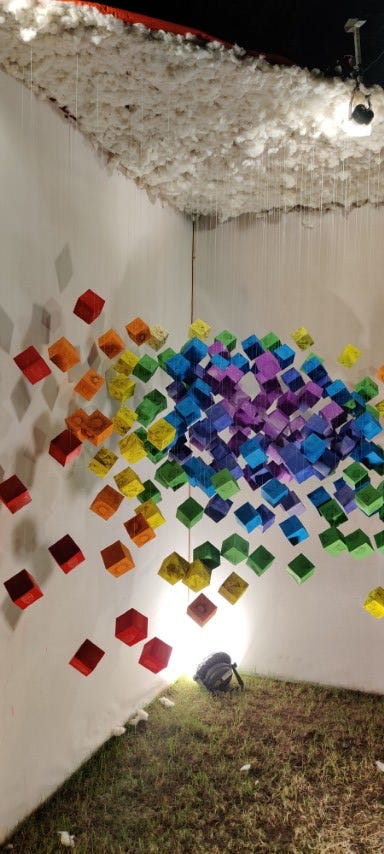
While I hold that everyone should visit this multi-week event at least once, I think this year’s (2025) curation was disappointing. May be all large-scale projects suffer from this inevitable descent. In case of Abhivyakti, it is striking because the exhibits were opposite of art. In fact, you should visit it if you want to see what opposite of arts look like. Everyone of us who visited the installation had one of these words at the top of our mind: ugly, dark, and disgusting.
It felt as if most exhibitors and performers were in a race to prove who could be uglier, darker, or more depressing. Not to mention un-innovating and uninspiring. (You can see it was so dark that I’m spreading their darkness to you, who hasn’t even visited it. Worry not, this is the first and last negative narrative in this essay.)
What is the purpose of art
An uninitiated layman would be fooled by visiting Abhivyakti. He would mistake the anti-art for art. At first, his gut would refuse to consider it art--and he would be right about it. But he would be forced to doubt his gut because those things are in a curated exhibition, making him think “I’m just a normal guy, what would I know about art?”
And it is not their fault to feel this way. Because we are trained to think that art is not for a layman. We are trained to think that art needs a high level of interpretation and abstract words and ooh and aah.
If you dig a little bit deeper, you’d realize that all this ho-ha and mechanics hide the main question we should be asking ourselves: “what is the purpose of art?”
Expression?
Catharsis?
Rebellion?
Entertainment?
None of them.
Historically, the purpose of art has been to educate, to show the light. That’s the original purpose. All other purposes are transgressions. You know as they say, “one man’s tool is another man’s weapon”. What we see nowadays in the name of art is not a tool, it is a weapon.
Art brings us closer to our potential, our virtues. Art educates us about what we could be: emotionally, humanly, socially, intimately. The aspects of our being that cannot be otherwise revealed to ourselves by intellectual exercises. I had heard something to the effect of: intellect’s purpose is to cut and dissect. That’s why we use the adjective “sharp” for intellect. If we have to use our intellect to “understand” art, we are doing something wrong. Art is not about dissecting. It is about integrating with our being by feeling it.
The gate-keeping of art
If the real purpose of art is to educate and show the light to people, why does understanding art feel like a chore? Like a riddle? Like arithmetic? That’s a valid question because if you think about it, what does an archetypal art-connoisseur look like? Just close your eyes and imagine how he would look like? He confidently stands in front of abstract dabs of paint on a canvas, in a silent art gallery. And seems to be deciphering a difficult riddle. He looks intelligent, sophisticated and a person with “taste”.
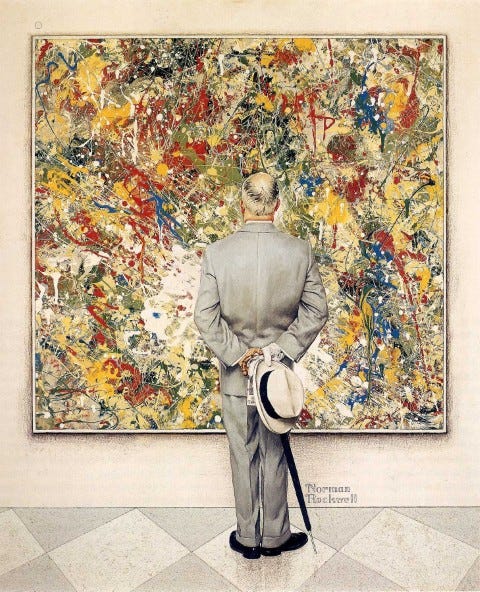
But, nine times out of ten, the piece he is standing in front of is not a piece of art. And he himself is not art-connoisseur. Standing in front of a broken toilet commode in a junkyard and acting to make sense of it doesn’t convert the junk toilet into an art piece and the actor into art-connoisseur.
The art-connoisseur is a self-appointed gate-keeper. He acts as an arbitrator of art. If he says your creation is a piece of art, then it is a piece of art. If he concludes that your creation is not a piece of art, then it is not art.
And you have no say in it. Because the art-connoisseur might have studied (or gathered through experience) different types of arts and their histories. He might be knowing the names of artists that you can’t even pronounce, let alone remember. He might have learned artsy vocabularies that go over your head. And this authorizes him to be the arbitrator of art?
By the same logic, a food connoisseur should be an authority to tell us which food is tasty and which one is not. It sounds ridiculous right? Because it is.
So why does understanding art feel like a chore?
Because that’s not art. Real, genuine art doesn’t ask us to solve some riddle hidden in them. They act as a medium--a tool--to show us what we could be or what the world could be, in its better form. The gate-keepers of art have an incentive to treat it as an exclusive club because I suspect, they are one of those individuals who haven’t seen the light themselves. And such individuals cannot let anyone else see the light. They use their all experiences and energy to make and keep the world dark, because it feels comfortable to them. Probably, they are not doing it consciously. They might be genuinely thinking what they are doing is right.
Real art is accessible
Above everything, I want the reader to understand that real, genuine art is accessible to everyone. It might carry multiple interpretations but we don’t need someone else’s certificate to tell us what is art and what is not.
We don’t need to be a suite-wearing intelligentsia, stumping our feet in silent museums and art galleries. We don’t need to. (In fact, education is a hindrance when it comes to appreciating real art.)
Look at this beautiful painting named La Siesta by Joaquin Sorolla y Bastida (told you, it is difficult to pronounce names of famous artists, but don’t be fooled by it. I don’t know how to pronounce this name and still, this is one of my favourite paintings):
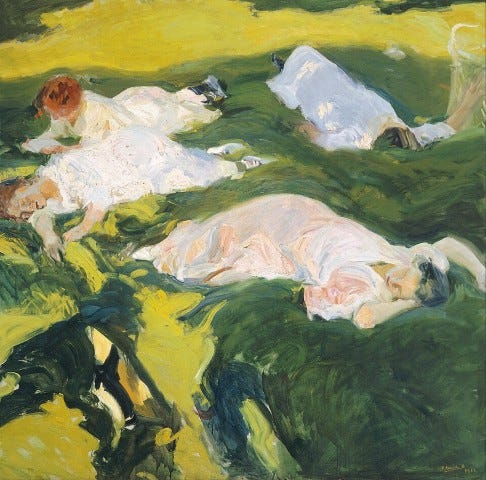
I came across this painting approximately 7 years back and it hasn’t left me.
As you look at this painting for a few seconds, you’d realize that no prior knowledge or training is required to feel the calm and leisure radiated by it. It simply transcends words and logic. It appeals to us city-folks to pause for a while during our speedy life and take a few moments of leisure. At least that’s what it reminds me of. Siesta has been important to me for all my life and this artwork by Sorolla just keeps reminding me of what I value in my life.
Of course, not every art piece may seem radiating positive spectrum of emotions. In those cases, mostly they represent some inspiring anecdote or a story. For example, look at this master piece by Ilya Repin. It is named “Ivan the Terrible and His Son Ivan on 16 November 1581.”
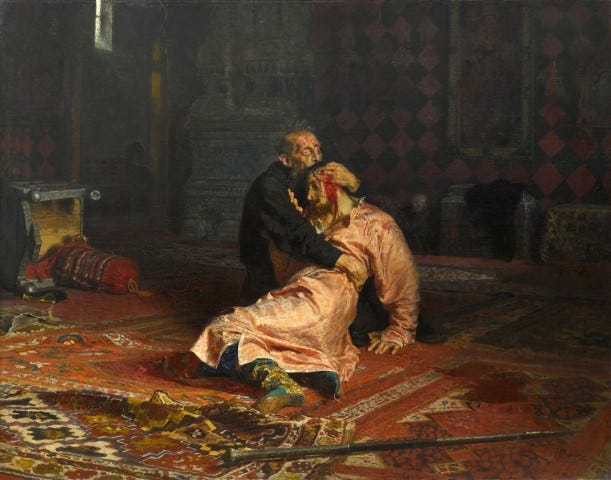
If you read the story that Repin has depicted on canvas 100 years back, every time you look at it, it will keep reminding you of how a momentary spurt of rage can leave us with a life-long regret. A regret and grief that is very much human. Again, you don’t need to be an art graduate to understand that what we see in the eyes of the man in the black robe, is horror. A self-inflicted, agonizing horror full of regret.
I had seen this painting first time while watching my favourite historical drama depicted in the mini-series Chernobyl.
Real art appeals to our higher selves
It calls our soul, the deepest corner of our being. It looks directly into its eye and shows it a reflection of what it is and what it can become. Sometimes we don’t need to become something new or improve. Sometimes, all our deepest being needs to hear is reassurance about our abilities and existence.
If you remember, a few months back, in my email titled “Where are our heroes?“, I had shared this illustration of Carthagian general Hannibal and his army crossing the Alps:

To me, this illustration sums up the courage, audacity and relentlessness of the human spirit. It appeals my soul to face fears and impossibilities no matter how difficult the situation gets.
Real art plays on the positive spectrum of emotions
Since a master artist can evoke any emotion that he wants, he can go in any direction: positive or negative. The artist can twist and turn his art piece for maximum impact.
For example, in 2016, two Chinese artists Sun Yuan and Peng Yu exhibited an industrial robot at one of the International Art Exhibitions in Venice. If you were to spend a couple of minutes watching this exhibit, you would feel tragic. A knot in your stomach. The exhibition was named “Can’t help myself”.
Have a look:
This is an example of triggering negative spectrum of emotions. I find it difficult to consider it real art. It is a great use of artistic technique for sure. But calling it art is probably last thing in my list. The problem with negative spectrum of emotions is that they take the person’s spirit to the abyss. The longer the person stays in that abyss, the longer they want to stay there. There’s a feel-good attraction to the abyss of negativity. It keeps people there through different golden cages: self-pity, victimization, misery etc.
“What about empathy?” you may ask.
I believe it is a made-up word to absorb people into someone else’s negativity. There’s no chance in hell that you would be able to walk in my shoes or I in yours. The most human thing I can do for you is develop compassion and not fake emotions based on my assumptions about how you might be feeling. Compassion is like an ocean in which any human can float, no matter how grave their sins.
Real art acts as a net positive force to the world
This used be a no-brainer but it is no longer the case. That’s why I’m making a point about it. Almost all art throughout the human history has been a net positive effect on the world: no matter how much money, time and labour is spent in producing that art, the effects of that art has paid dividends to people in tangibles and intangibles. Especially intangibles.
Art has been used in providing moral, emotional, and religious education. The qualities of beauty, valour, compassion, love, dignity, sacrifice, honour, innocence, justice, etc. could be communicated through art. And if you have tried your hand at teaching people, you’d agree that these are difficult concepts to put into words. But a master artist can communicate these qualities in a jiffy.
For example, this exchange between two characters in the Hollywood modern classic Good Will Hunting encapsulates what we are talking about art. In fact, this movie is a master art on so many levels. Bear with this wall of text, or you can watch one of the greatest 5-minute scene in the history of cinema:
Transcript:
Sean: [sitting on a bench in in front of a pond in park] Thought about what you said to me the other day, about my painting. Stayed up half the night thinking about it. Something occurred to me... fell into a deep peaceful sleep, and haven’t thought about you since. Do you know what occurred to me?
Will: No.
Sean: You’re just a kid, you don’t have the faintest idea what you’re talkin’ about.
Will: Why thank you.
Sean: It’s all right. You’ve never been out of Boston.
Will: Nope.
Sean: So if I asked you about art, you’d probably give me the skinny on every art book ever written. Michelangelo, you know a lot about him. Life’s work, political aspirations, him and the pope, sexual orientations, the whole works, right? But I’ll bet you can’t tell me what it smells like in the Sistine Chapel. You’ve never actually stood there and looked up at that beautiful ceiling; seen that. If I ask you about women, you’d probably give me a syllabus about your personal favorites. You may have even been laid a few times. But you can’t tell me what it feels like to wake up next to a woman and feel truly happy. You’re a tough kid. And I’d ask you about war, you’d probably throw Shakespeare at me, right, “once more unto the breach dear friends.” But you’ve never been near one. You’ve never held your best friend’s head in your lap, watch him gasp his last breath looking to you for help. I’d ask you about love, you’d probably quote me a sonnet. But you’ve never looked at a woman and been totally vulnerable. Known someone that could level you with her eyes, feeling like God put an angel on earth just for you. Who could rescue you from the depths of hell. And you wouldn’t know what it’s like to be her angel, to have that love for her, be there forever, through anything, through cancer. And you wouldn’t know about sleeping sitting up in the hospital room for two months, holding her hand, because the doctors could see in your eyes, that the terms “visiting hours” don’t apply to you. You don’t know about real loss, ‘cause it only occurs when you’ve loved something more than you love yourself. And I doubt you’ve ever dared to love anybody that much. And look at you... I don’t see an intelligent, confident man... I see a cocky, scared shitless kid. But you’re a genius Will. No one denies that. No one could possibly understand the depths of you. But you presume to know everything about me because you saw a painting of mine, and you ripped my fucking life apart. You’re an orphan right?
[Will nods]
Sean: You think I know the first thing about how hard your life has been, how you feel, who you are, because I read Oliver Twist? Does that encapsulate you? Personally... I don’t give a shit about all that, because you know what, I can’t learn anything from you, I can’t read in some fuckin’ book. Unless you want to talk about you, who you are. Then I’m fascinated. I’m in. But you don’t want to do that do you sport? You’re terrified of what you might say. Your move, chief.
When Matt Damon and Ben Affleck wrote this scene, they were 27 and 30 years old, respectively. The writers, the director and specially the actor Robin Williams produced this master piece.
Why should we bother?
In the modern society, almost all parents have outsourced the responsibility to educate their children to the State. The State regulates what the children get to learn and what ideas they get exposed to.
If we agree on the importance of values in our lives, then we also need to acknowledge that they’re too important to be outsourced to the schools and universities. Schools are neither equipped nor incentivized to impart important human values in a classroom.
Because the State has no incentive to inculcate qualities of a good human being. The State’s main interest lies in extraction of as much labour and monetary value as possible from all its citizens. Our children are not special to the State. They’re future tax-payers and we, the current ones.
Plus, it is generally accepted that the condition of schools and universities have improved over the past century. The main measurement being the literacy rate, graduation rate and earning power etc. In such a scenario, educating ourselves and children about art may seem unimportant because why bother about higher values when the child can say sorry and thank you, show respect to authorities, earn good amount of money, defend the idea of democracy, can travel for leisure or advocate for therapy and empathy for all?
I want to argue that we need to bother ourselves because of these same reasons. What I described is not a well-rounded individual BUT a well-indoctrinated individual. Literacy and vocational training is not equal to education.
How to educate ourselves and children about art
We have firmly established that the purpose of art is to appeal to our higher selves. Keeping this North Star in mind is useful.
Art education starts at home.
First, with values.
It is in those little moments that parents and the society create: helping someone with money, time or kindness who cannot return the favour. Showing gratitude for the things and people they have in their lives. Fighting for the values they hold close to their heart. Practicing in private what they preach in public. Insisting on duties while talking about rights in their immediate context. When practiced naturally on a daily basis. Not as an algorithm. Every one of us have seen/been parents with an obsessive robot-like insistence on “polite” behaviours. “Say thank you. Did you ask him before taking the pencil? Apologize to her. Say goodbye..”. These are not values. They’re etiquettes. (Even the Prince Andrew has more etiquettes than all of us would ever have, but he holds less values than a middle class working man.)
Creating value-based practice and environment on a daily basis reinforces the importance of values. It also primes our mind to instinctively recognize them in different art forms. The quote “beauty is in the eyes of beholder” does not mean truth is different for different people. It really means “only those whose minds are unsoiled can see the beauty”.
Second, the art pieces.
There is really no rocket science to recognizing art. We can remove our doubts about our understanding of art by looking at photos and paintings we like, reading novels, watching movies, listening to songs or just visiting beach or mountains, delving into different experiences. Things that inspire us and appeal to higher selves. We can call them art. No need for an authority to certify it as an art.
We are free to print a 5 by 5 poster of our family picnic or a nostalgic moment or poster of Silvester Stallone’s movie Rocky, paste it on our home wall and call it art. Because that is what inspires us and fills us with hope.
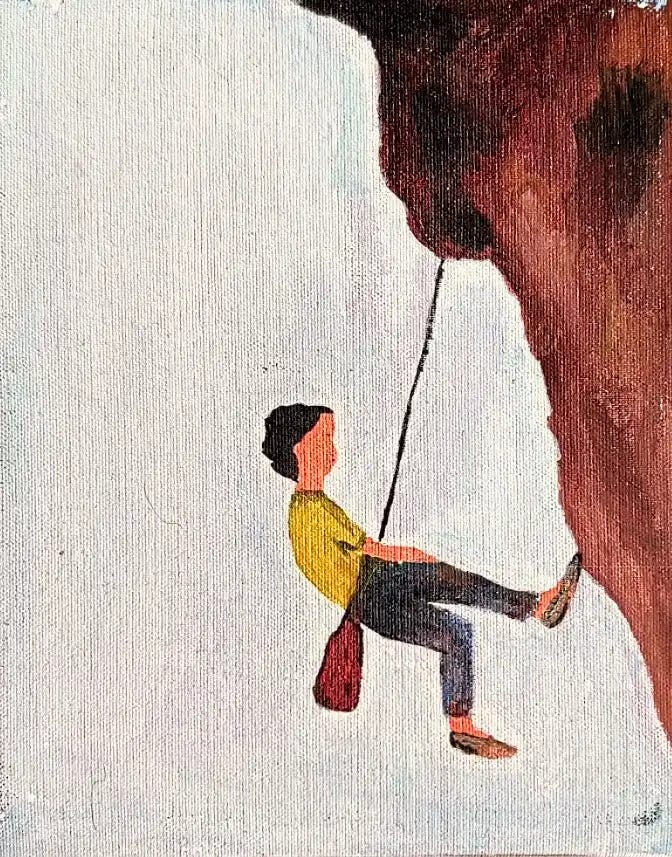
Of course, this does not mean that any abstract and down-right gibberish expression is art. I still remember reading about one of the IAS officers’ painting exhibition published in the local newspaper. This was approximately 15 years ago. The heading of the clip was “I don’t name my paintings.” I looked at his several paintings printed in the newspaper. No wonder no one can name his painting anything. Because they were nothing. Just some random dabs of paint thrown on the canvas. It was not art. I suspect, everyone knew it but who would tell the emperor he had no clothes on?
Third, travelling.
In the previous paragraph, I briefly mentioned going through different experiences as for art education. I want to draw your attention to the experience of travelling. It is one of the easiest form of experiences in art anyone can have. Travelling to natural landscape, ocean, forest...whatever floats our boat. And there is a particular type of travel that can teach us about real art: visiting ancient architectural sites in the West or in the East.
In the movie Good Will Hunting, the Robin Williams’ character tells the Matt Damon’s character:
Sean: “[…] But I’ll bet you can’t tell me what it smells like in the Sistine Chapel. You’ve never actually stood there and looked up at that beautiful ceiling; seen that. […] “
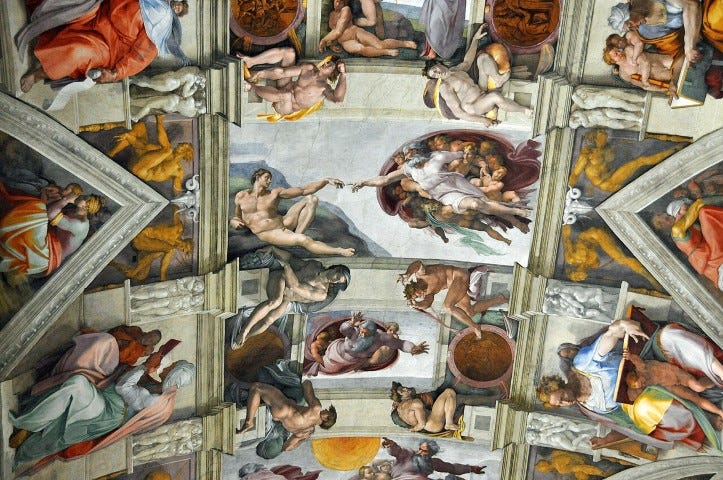
Why would Robin Williams try to humiliate a bright young man by talking about his lack of travelling outside Boston? The reason is simple: if the young Matt Damon had indeed acquired the knowledge through travel, he would have let go of his arrogance. For example, if he had visited Vatican City and paid visit to the Sistine Chapel, he would have marvelled at Michelangelo’s 5000 square feet beautiful fresco on its ceiling. His heart would have been blushed with the wonder and humility that only can be felt by facing something larger than ourselves and our abilities. In short, such travels would have educated him the most important human values through experience.
All this to say that art is not mysterious. It is not something to be dissected or understood. We can recognize the real art in our day to day life and create an environment that uplifts our lives and souls.
Art is the most powerful educational tool we have. It is our moral duty to recognize the real art and create opportunities for children to experience the beauty of art. That would be the real renaissance and change-making.
Let me close with this beautiful music and its performance in the outer space by Sarah Gillis during the SpaceX Polaris Dawn mission in 2024. If you let yourself immerse for just 3 minutes, you would get goosebumps. That’s art.