

Who is your hero?
Not someone you’ve met, seen a photograph of or known “facts” about. I’m talking about someone you didn’t bother about details or facts. A hero who projects the highest of your potential in virtue. When you think about this hero, all you can think about is his struggle and success of bending the world as per his vision.
Do you know where we find those heroes? In stories. In history.
The stories that we grow up with, provides us our heroes. But I was recently wondering, how often children and people think about their heroes nowadays? I doubt they even have their heroes. The heroes they think they have, are mostly entertainers: dancers, actors, singers, sportsmen, authors, two-bit politicians etc.
These people are not heroes. They’re false heroes created by the culture so that we don’t bother ourselves about discovering the real heroes. The way people have “lucky charms”, I believe everyone can have a set of heroes they resonate the most with. We may have some overlapping heroes but the intensity with which they resonate with our hearts are unique.
Hitting 10,000 runs on a cricket ground might be a feat of the player. But that doesn’t set an aspirational vision for our “self”. There is nothing really heroic about it.
I believe the real heroes are the ones who set the bar of character so high that we know that even if we spend our entire lifetime, we will never be able to surpass it. And that is no cause of demoralization. In fact, his story inspires us. Especially during the dark times. Sometimes I think, it is this “invincible summer” within us that Albert Camus has referred to in his beautiful poem:
In the midst of hate, I found there was,
within me, an invincible love.
In the midst of tears, I found there was,
within me, an invincible smile.
In the midst of chaos, I found there was,
within me, an invincible calm…
In the midst of winter, I found there was,
within me, an invincible summer.
And that makes me happy. For it says that
no matter how hard the world pushes against me,
within me, there’s something stronger –
something better, pushing right back.
It is these heroes, who give our soul the much-needed nourishment in the times of despair or highs of euphoria. We don’t need to dissect their life. We don’t need to know how they looked like. We don’t need to know all the tiny noise of their life.
But for some strange reasons, in our increasingly info-rich culture, it is almost a taboo to have a hero and not know his whole janma-patrika. Do I need to know which god did the Carthaginian general Hannibal believe in to qualify him to be my hero? Isn’t just knowing his war campaign stories against Rome during Punic Wars enough? More than two thousand years ago, this man Hannibal, single-handedly led 30-40000 troops across the Alps mountain range to attack Rome located more than 1500 km away! It was the same Hannibal’s troops who massacred more than 40000 Roman soldiers in a few hours during their battle at Lake Trasimene. It was the same Hannibal who stayed away from homeland for more than 15 years fighting against the enemy Rome. It was the same Hannibal who was made commander-in-chief of the army at the age of 26.
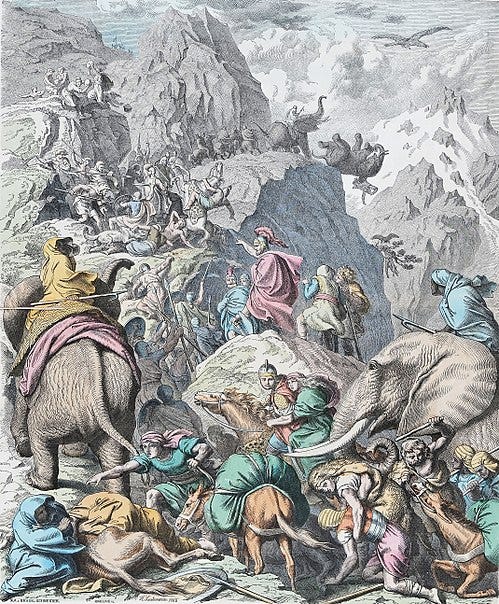
I don’t need to learn about Hannibal’s personal life, his food habits, his education, his family or his wealth. Whatever I need to learn about him, the most important of all: his character in the face of adversity, is sufficient to me. In fact, that’s the only thing that counts. Hannibal is a shorthand in my mind for the quality of character I can’t articulate but my mind understands and I need to cultivate. All of us have or can have such ten-twenty heroes filling in the space for different qualities that truly matter.
And what kind of heroes and their stories are the schools teaching our kids today?
Heroes who were meek. Heroes who declared non-violence the only virtue and ostracized the utility of violence. Heroes who lobbied for getting rid of free thinking. Heroes who tried to destroy the idea of gods so that our children can be more scientific and “secular”. Heroes who passed on the mantras to never question authorities. Heroes who made us doubt our human potential. Heroes who sanctioned social engineering in the name of social justice. Heroes who used religion as a tool to concentrate power. Heroes who played victim. Heroes who didn’t show the strength of character.
These false heroes do not nourish our souls, nor our children’s souls.
We are all humans and we will falter. But that is no excuse for not discovering our heroes. Or denying our children the heroes they need. Because during the toughest trials of life, we do not turn to the false heroes. We can’t. Our heart knows that. So we turn towards the only thing we know that will numb our pain: our addictions and entertainment.
Turning towards real heroes make the life liveable. They let us taste the full human experience.
Don’t deny yourself and your children heroes. Real heroes.
PS: A few words on political correctness. If it stung you anywhere that in this write-up, all I used was “he” or “his”, you have a deep reflection to carry out. A few years back, a young, female reader had reached out to me, protesting that my language felt “exclusionary” as most of my writing didn’t contain “she”. I had to muster all the love I had and politely ask her to revisit her premise about my role as a writer because it didn’t include meeting anyone’s expectation.
I don’t think she reads or engages with my writing anymore because the infection of certain ideological virus is so strong that it creates a strong isolation layer and ultimately kills its host. (Read the end note about Virginia Woolf and you’ll know what I mean.)
In any case, this depolarization of masculine and feminine in the world due to political correctness has permeated stories too. The stories are methodically castrated. No wonder they do not yield any hero: male or female.
PPS: The algorithm threw this excellent addendum-worthy post at me, reprinting it here as I found:
“I detest the masculine point of view. I am bored by his heroism, virtue and honour. I think the best these men can do is not talk about themselves anymore” - Virginia Woolf
megha_lilly writes: “Virginia Woolf famously writes that the stories of great men and their accomplishments bore her, and this attitude of a feigned, petulant ennui and thinly veiled resentment against great men is precisely the attitude that describes not merely the emotional foundation of feminism, but also that of Marxism in general. This is what makes both of these ideas fundamentally “anti-civilizational”. If great men are the only ones who can build civilisation, then to hate and undermine great men can only lead to its destruction.” Superb!
No wonder, Virginia Woolf killed herself by diving into a river. Any wonder that the torch-bearer of a hateful ideology lived a depressing life and met such a death? And now that depression engulfs more than half of our population. Sad reality, but hey, discover your heroes. They’re the firewall for all mind viruses.